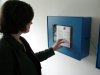



scannermobile vom 13. märz bis zum 29. mai 2005 im Wohnzimmer von claudia kugler & hans-jürgen hafner
scanner.mobil
(Blank & Jeron, Multiple, 2002)
scannermobile
vom 13. märz bis zum 29. mai 2005 im Wohnzimmer von
claudia kugler & hans-jürgen hafner
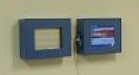
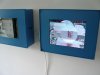

In Anlehnung an scanner++
(1998) wird mittels Scanner und angeschlossenem Computer ein
digitales Bild erzeugt.
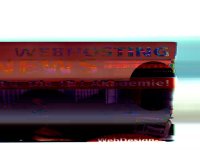
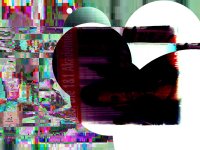
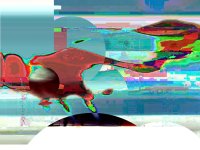
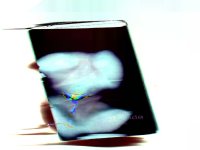
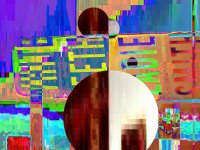
Der Scanner arbeitet kontinuierlich und ohne Pause. Er erfasst und digitalisiert die von Besuchern auf den Scanner gelegten Objekte. Im anschließenden Prozeß wird dann der errechnete Unterschied von dem zuletzt und dem aktuell gescannten Bild abgebildet. Dabei wird jedes Pixel des vorherigen Scans mit dem korrespodierenden Pixel des aktuellen Scans verglichen. Dieses Verfahren bewirkt dass der Scanprozess keine Informationen löscht, sondern alle Scans zu einem einzigen Bild verdichtet. Was zu sehen ist, ist die Spur der vom Scanner erfassten Informationen. Einzig zufällig eingestreute weiße Kreise sorgen für Ruhezonen die den aktuellen Scan zumindest teilweise im Original abbilden. Neben den vom Scanner erfassen Objekten beeinflusst auch die Lichtsituation im Raum das Ergebnis.
Arbeiten mit Scanner gibt es neben den Multiples auch als be- gehbare Rauminszenierungen. (scanner++, scanner.lite, scanner.mobile)
6 Ergebnisse als Beispiel des Bildverarbeitungsprozess :

Gerrit Gohlke about scanner++ :
Shoe seeking contact with monitor screen scrapes along a gregarious computer exterior whose normally thin film of signs and hints usually appeals either to the intelligence or simply -- and perhaps this is closer to the truth -- an abject sense of administrative order. Here it is: the long-awaited flickering monitor screen you can touch with the feet as opposed to keyboard-tapping fingers. Access to the computer is a fraud engineered our faculty of sight, a deception users meekly tolerate as long as they are kept at arm’s length from the fluorescent rectangle. But now the lived body steps onto the projection surface of its inhabitant’s desires, and for once the users are on top of the desktop – courtesy of Joachim Blank & Karl Heinz Jeron.
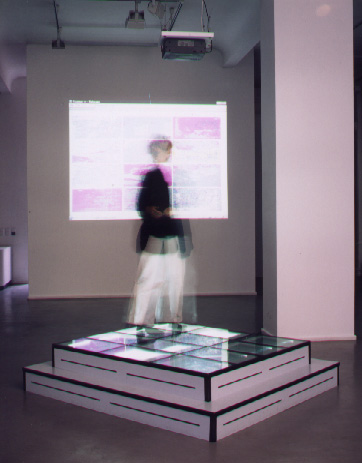
Or so it seems at first. Actually, they’re standing not on the monitor but on its symmetrical counterpart, the scanner -- a reading device that with schematic, flat abandon digitizes graphic images and documents, then feeds them into the computer. Scanner++ is the name the artists gave to a catwalk composed of a dozen panes of glass, each one the size of a school-issue drawing block. Beneath them is the same number of flatbed scanners, all recording the world in treadmill rhythm. The captured world is 20 centimetres shallow – copying machines being short-sighted devices that precisely reproduce any object in the immediate vicinity but reduce to impenetrable black blobs anything more remote. Mindlessly obeying an algorithmic choreography, the machine plots and maps out its overhead audience of shoe-soles, while the heads of the shoe-wearers remain exempt from mechanical reproduction.
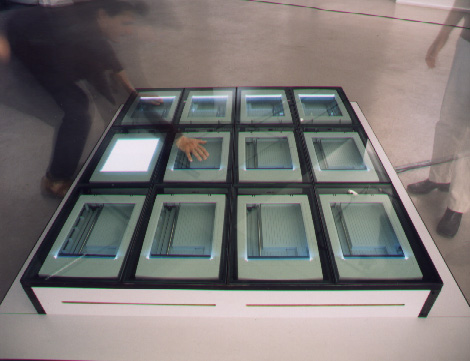
Blank & Jeron’s touchy-feely apparatus thus dictates the conditions under which its users’ physiques are rendered legible. In some peculiar way, Scanner++ is a mechanical disciple of the faded utopia once cherished by the pioneering generation of Internet enthusiasts. Just as the latter dreamt that the nascent global electronic network would liberate its community by disembodying it, the human embrace of Scanner++ is indiscriminate, interested solely in people’s proximity to the technical surface, and reads into the brief encounter nothing more than data and characters. Imprinted on the computer’s sensory organ are merely the footsteps of random flaneurs: solid enough, but devoid of the idealistic superstructure.
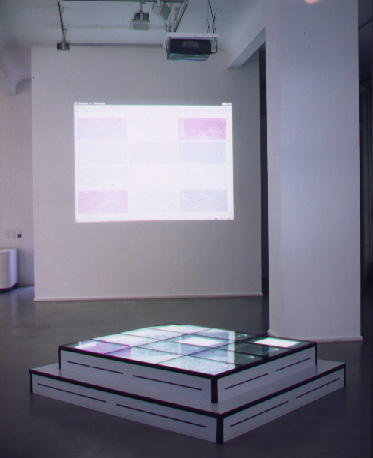
Following
a mathematical scheme, the apparatus generates snapshots of a
spatially truncated reality, images the state-of-things from a
mechanistic, limited viewpoint. The copies are projected onto three
sets of four surfaces on the wall opposite the scanners – the
arrangement mirror-images the installation – and simultaneously
made accessible over the Internet on a monitor. A screen is presented
to us as a mirror behind which, apparently, there are people
standing. We see them from below, the soles of their feet stare at us
from the monitor. Senseless visual aids glued to our screens.
Yet they don’t really look like the flies that sometimes settle on our monitors. Our rudimentary technologies turn physical objects into abstract schemes, and in front of us is a selection menu. Each of the twelve fields is really a stack of pictures, not unlike a deck of cards, the image visible at any one time merely topmost in a chronologically ordered pile. The user can pick up one picture, then discard it and move onto the next, curious to know if there are better prospects in store.